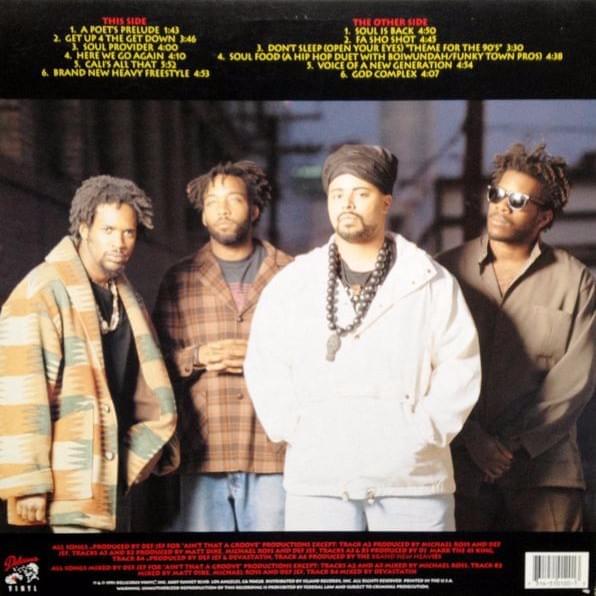
Seeing BET recently highlight the Soul Brothers made me stop and reflect on something much more personal than their place in hip-hop history.
It made me think about where my own history in hip-hop began.
For me, that story goes back to around 1993.
I was 14 years old. I was writing rhymes every day. I was hungry. I was trying to find my voice and figure out who I was going to become as an artist.
And then I met V-LUV of the Soul Brothers.
I can still remember going to his house and walking into the living room. He had an Akai MPC60 II set up with speakers, and he was making beats.
And his beats were fire.
I didn’t realize it at the time, but I was standing at the beginning of something that would affect the rest of my creative life.
V-LUV saw something in me. He took a chance on a 14-year-old kid who loved hip-hop and wanted desperately to be part of it. He produced me. He made beats for me. He helped me make my early demos.
I remember taking the bus to his house when I was 14 or 15 years old so we could work on music.
That was my introduction to beat machines.
That was my introduction to production.
That was my introduction to the MPC.
And when I zoom out today, I realize just how significant that beginning really was.
The Soul Brothers
The Soul Brothers weren’t simply dancers who happened to appear in hip-hop videos.
To me, they were part of the pulse of hip-hop culture.
If you wanted to know where the culture was at during that era—what records were moving people, what styles were emerging, what the energy felt like—you could see it vibrating through the Soul Brothers.
They appeared in countless videos and performances. They were connected to the Delicious Vinyl family. They danced alongside artists such as Def Jef and appeared throughout a period of hip-hop that helped define the culture.
They were on In Living Color. They appeared on The Arsenio Hall Show. They performed around the world.
They even crossed paths with my favorite group of all time, the Brand New Heavies.
And the list goes on.
BET’s recent piece does a great job capturing part of that history. Inevitably, though, a short feature can only show so much. There are appearances, performances and moments scattered throughout that era that collectively tell a much larger story.
That’s one reason I wanted to write this.
Because I can tell another small piece of that story from my own experience.
V-LUV the Producer
There’s something else about V-LUV that I don’t think should be overlooked.
Think about the perspective a dancer like V-LUV brings to making a beat.
A great dancer doesn’t just hear music.
He understands where it moves you.
He understands rhythm physically. He understands the pocket. He understands what makes somebody react before they even consciously understand why they’re reacting.
And when someone with that background becomes a producer, they’re drawing from an enormous internal database—not only of hip-hop records, but funk, soul, breaks, samples, movement and years of actually participating in the culture.
V-LUV wasn’t studying hip-hop from the outside.
He was already contributing to it.
So when he sat behind that MPC and started chopping records and building beats, all of that history came through the machine.
As a kid trying to become an MC, I couldn’t have asked for a much better place to begin.
My Beginning
I want to be clear about my personal relationship with the Soul Brothers because I don’t want to rewrite history or imply relationships that I didn’t have.
My closest connections were with V-LUV and Kraig E.
I didn’t spend that same kind of time around Legend, so when I talk about my beginnings with the Soul Brothers, I’m primarily speaking from my experiences with V-LUV and Kraig E.
But those experiences run deep.
Even before the generation of artists I would eventually come up alongside, there were already connections being formed. Tak from Styles of Beyond was on one of my early demos with the Soul Brothers.
V-LUV produced that demo.
That’s how far back this goes.
Years later, when I look at the artists and groups who were part of my broader cohort and the underground Los Angeles hip-hop world around me—Styles of Beyond, Emanon (Aloe Blacc and Exile), Abnormal and others—I can trace my own path backward.
And eventually I always arrive at that same living room.
A kid.
An MPC60 II.
And V-LUV making beats.
There Is No Pharaoh MC Without the Soul Brothers
That’s really the reason I’m writing this.
I don’t believe there is a Pharaoh MC without the Soul Brothers.
I don’t believe I become a beatmaker without that experience.
And when I think about Terrorism ERA, an album that became such an important piece of my own artistic history, I don’t know that I ever make it that far without what began years earlier with V-LUV.
Today, that connection continues through HeavieHead, a crew whose history goes back to the early ’90s. I was HeavieHead then, and I’m HeavieHead now.
More than three decades later, V-LUV and I are still brothers.
There is mutual respect there that comes from a history that can’t be manufactured.
He believed in me when I was a kid.
And I’ve never forgotten it.
When I zoom all the way out and look at anything I’ve managed to accomplish creatively, I see pieces of those beginnings everywhere.
The writing.
The records.
The production.
The MPC.
Terrorism ERA.
All of it.
Somewhere inside that DNA is a 14-year-old kid taking the bus to V-LUV’s house because somebody who had already lived and contributed to hip-hop culture was willing to open the door and let him participate.
That’s why seeing the Soul Brothers receive recognition means something different to me.
I’m not only watching a piece of hip-hop history.
I’m watching a piece of my own history.
And I wanted to take a moment to acknowledge that publicly.
To V-LUV, Kraig E, Legend, and the Soul Brothers:
Thank you for what you contributed to hip-hop.
Thank you for the history.
And on a personal level, thank you for being there at the beginning of mine.
The Soul Brothers will forever be part of my hip-hop DNA.
And there is no Pharaoh MC without them.